Tuesday, 23 December 2008

Facilitating Innovation Through Knowledge

A key element in the success of organisations is their ability to capture, manage and share knowledge, learning and best practice amongst the workforce. However knowledge is often confused with information, and thus organisations typically address the issue by implementing mechanisms for collating documented information and making it available for people to access. (See my earlier post on Developing Knowledge Sharing Communities for Business)

What this usually results in is some form of electronic library available through intranet or shared folder access, but little or no attempt to encourage discussion and evolution of that information for wider organisational use. People are left with the responsibility of connecting disparate bits of information into appliable knowledge. The amount of effort needed to do this is often prohibitive and the result is that people typically ignore the majority of information available to them and organisations are unable to leverage the pools of knowledge they hold.

Studies show that innovation arises at the confluence of knowledge from different fields, so in economic downturns like this, surfacing and sharing knowledge could be a crucial factor in survival.

In light of that, here's a quick look at the different avenues that people use to find and engage with information.

Mechanisms For Finding Knowledge

Thursday, 11 December 2008

5 Tools To Track Social Conversations

As more and more business begin to appreciate the value of managing and monitoring social conversations to build their brand and reputation, marketers are beginning to move away from focusing manual search, monitoring, trafficking, and tracking. Instead, many aggregation and tracking tools, in addition to stealth services not yet launched, are not only helping track keywords, but also monitor conversations across the networks and communities that you know and don't know. They effectively map, engage, and manage participation efforts allowing businesses to start to implement and benefit from CRM-style (customer relationship management) dashboards and hubs to streamline internal and outbound communications.

Here's 5 tools you should be looking at as you develop your own social marketing strategies

  1. BuzzLogic
  2. Radian6
  3. BuzzGain
  4. BrandsEye
  5. Brandwatch


(Taken from Brian Solis' post on the state of social media - http://www.briansolis.com/2008/09/state-of-social-media-2008.html)

Monday, 17 November 2008

Financial Sustainability

If you're wondering why there hasn't been much posting activity for the past week or so, it's not because I've hit writer's block. The past few weeks have been a whirlwind of activity, between deadlines at work and trying everything possible to ward off insolvency for one of the charities I'm involved with. I'll put up some of the things we've learnt once things ease up. Hopefully find out this week if my efforts have come to anything.

The credit crunch is playing its part here, and safe bets suddenly look like big risks when there's no margin for error. The real challenge has been trying to create viable commercial revenue streams for a charity that traditionally hasn't had any. A lot of lateral thinking later, we might be getting somewhere. The difficulties lie in financial modeling for a space that hasn't really got much else to use as reference.

Moving a charity from being grant dependent to becoming financially sustainable requires more than just identifying revenue streams. It requires a change of focus and ways of working. It requires new management skills, and new engagement skills. Dealing with corporations is a whole different exercise to dealing with government or third sector bodies. Lots of challenges but exciting nevertheless. Where there's a will there's a way... and in this case there definitely is a will!!

Watch this space for an overview of what I'm learning about the realities of financial sustainability and business remodelling in the third sector...

Saturday, 18 October 2008

Life After The Credit Crunch

Here's a presentation with some great observations on life after the credit crunch, collated by Ines Seidel.

Life After the Crunch
View SlideShare presentation or Upload your own. (tags: social life)


In summary, there's the things we already know like there are more fears, and people are cutting down and shopping more frugally, but what I really like is that she has drawn out some personal things like the fact that people are discovering family as they look for more free things to do, and kids are learning to accept no for an answer.

For fashion retailers however, there's a great point in here about the need for clothing that will survive trends and frequent use over the next couple of years.

Thursday, 9 October 2008

Customer-centric Innovation

Great presentation on customer-centric innovation. The drivers for this are that traditional innovation is broken and the nature of competition is changing. Think left-wing rather than direct.

Saturday, 4 October 2008

Your Essential Guide To Social Media

As a business you still probably don't care about Social Media. Your marketing department is still churning out brochures and adverts and telling you that this is all far future stuff. Only kids mess around with the internet. If so, they're killing your business. The UK alone has 17.1 million active internet users in the 16-54 age bracket - that's your primary consumer base. Worse still, Universal McCann research shows that 1 million of them have shared an opinion about a brand or product within their social networks. Trusted opinions are the number 1 factor in the purchasing decision-making process. Do you have any idea what they're saying about you, let alone any clue about how to manage that conversation?

Well for starters, you really need some idea about what Social Media is, and while I put together something simple that's specific to businesses, here's a decent guide.

Monday, 29 September 2008

Developing Knowledge Sharing Communities For Businesses

One of the biggest problems facing most organisations is a combination of poor internal information sharing mechanisms and a lack of a collaboration culture. Since both are key foundations of innovation, this issue has serious consequences for organisational growth and success.

In my experience I've found that this problem is tackled one of two ways...

  1. Primarily through chucking technology at it - usually some kind of intranet with out of the box functionality, and
  2. Occasionally through culture change programmes.

There is often a belief amongst those implementing culture and business change that the change is technology independent. Conversely a lot of user experience professionals believe that behavioural issues can simply be addressed by making sure the interface and functionality of systems are compelling. Fact is that in this context, neither works without the other.

Driving highly collaborative and social sharing behaviours is pointless if the mechanisms for capturing and disseminating collective knowledge do not exist satisfactorily; and it is similarly pointless providing document sharing capability without a culture that encourages and rewards participating and interaction.

My advice is to develop and evolve your technology and culture together, with technology just preceding culture change activity in order to facilitate the human journey from hoarding documents and content, to sharing, to evolving it, to interacting socially around it.

I've created a 3 step Knowledge Management maturity model to show you how you might set this up for your business by increasing the richness of technological and social interaction over time.

  1. Information Management - The journey starts with Information Management through using fixed and free tags along with decent search capability to surface content. Fixed tagging helps structure content. Encouraging free tagging begins to make people feel they can interact with the content, which sets them up nicely for the next stage.
  2. Knowledge Management - Adding rating and commenting begins to allow qualitative evolution of information, which is essentially the core of knowledge management and also embeds the rudiments of inter-personal interaction around knowledge that facilitates off-line niche or special interest interaction.
  3. Social Interaction - Finally adding presence information and real time discussion (chat) capability combined with offline community days begins to drive widespread and cross-functional social interaction around information and knowledge sharing, which is really where you want to be as an organisation.
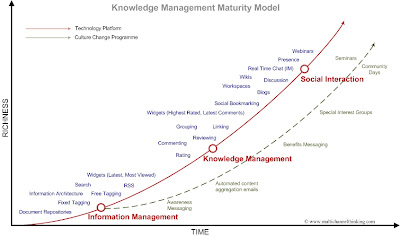
Knowledge Management Maturity Model

Hope it helps!